by Carol Adams (the views expressed are my own and no agreement by any other party can be assumed)
The purpose of this piece to address a few things that have been said over the last few months and set out some possibilities for the future of corporate reporting aligned with sustainable development.
What’s been said and a response
You shouldn’t say that a purpose of corporate reporting standards is change
Apparently some people don’t like it and yes, change is hard, but it must happen for the benefit of all of us (including investors). There has been a stack of research that says frameworks and standards for reporting drive change whether intended of not. So the responsible approach for standard setters is to state their purpose so they can be held accountable. For example, the External Reporting Board of NZ states:
The ultimate aim of Aotearoa New Zealand Climate Standards is to support the allocation of capital toward activities that are consistent with a transition to a low-emissions, climate-resilient future.
NZ CS 1
GRI Standards require disclosures on how sustainable development considerations are integrated into governance oversight, strategy and policies thus facilitating a shift that is aligned with sustainable development. They state:
The GRI Standards enable an organization to publicly disclose its most significant impacts on the economy, environment, and people, including impacts on their human rights and how the organization manages these impacts.
GRI 1 (emphasis added – we are not asking an organisation to count everything that matters to all its stakeholders)
All information in annual reports is financial information by definition
This comes from definitions of annual reports by some accounting standard setters and financial regulators that stating that investors are their primary users. Do boards really prioritise investors when approving annual reports? Can we do away with ESG rating agencies and benchmarking organisations then?
The front end of annual reports has expanded rapidly since around the 1960s and does not appear to be written with investors solely, or even mainly, in mind. And even if it were, that wouldn’t make it all ‘financial’ information (and therefore, presumably, the territory of accountants, whilst information not in the annual report is the territory of others).
Initially, the front end of annual reports was aimed primarily at staff and changing the perception of customers and broader society (I’ve waded through annual reports on mircofiche of banking and retail companies going back to the first half of the last century). More recently, the most informative integrated reports are those that set out their key stakeholders and how they create value for them (i.e. not just investors). These reports tend to include their most significant impacts using GRI Standards.
Accountants like counting, but of course not everything that matters can be counted and most of it can’t be measured in $s or Euros, etc and trying to do so could quite likely force attention in the wrong direction. But what matters can and should be disclosed.
GRI Standards are for stakeholders other than investors
I’ve addressed this before, but it is worth mentioning new evidence (a survey conducted by Institutional Investor Services Inc.) that 75% of investors want reporting on an organisation’s most significant impacts (31% want it whether or not it might become financially material and a further 44% because it can be expected to influence the company’s financial performance in the medium to long term). And the Securities and Exchange Board of India has mandated reporting on impacts aligned with GRI Standards. (Having seen pressing sustainable development issues in a recent visit with Eelco van der Enden and Bronte Klein to celebrate 10 years of the GRI office in India under the leadership of Dr Aditi Halder, this is clearly appropriate).
This is why GRI’s Global Sustainability Standards Board (GSSB) has commenced a piece work on guidance to identify the risks and opportunities that arise from an organisation’s impacts. And GRI has involved investors in all its standards development work since 2016 (as well as all governance bodies). It’s clear that organisations want and need this information to monitor the most significant impacts of organisations in their supply chain too, because its the right thing to do and lest they should become risks. (Think human rights issues, labour rights issues, pollution and then companies like Nike.)
Some national and jurisdictional standard setters I’ve spoken with are concerned that overall reporting might temporarily go backwards as they develop standards meeting the requirements of financial regulators. Perhaps it will, temporarily, as companies focus on compliance – but long term companies and other organisations know what they want and need to convey. And they know more regulation will come.
Frameworks and Standards allow organisations to look good while greenwashing
Responsibility for greenwashing lies with organisations. Organisations mostly chose to greenwash and sometimes do it inadvertantly because they don’t have rigorous management and governance process. There is substantial research evidence on greenwashing and an army of researchers and investigative journalists seeking to uncover it and suggest the complicity of standard setters.
There are a number of ways to prevent greenwashing: Regulation, enforcement, external assurance and education/training. Perhaps most pressing now are:
- Mandating disclosure of the process of determining an organisation’s most significant impacts; and,
- Assurance over that process.
If 1. is not mandated, investors and others cannot be sure an organisation has disclosed a complete list of its most significant impacts and hence that it has the information it needs to disclose significant risks. And if the scope of assurance engagements doesn’t cover it, they still don’t know. (GRI people support the work of the International Assurance and Auditing Standards Board on the ISSA 5000 Exposure Draft and have attended focus groups – I was in Sydney.)
The future of corporate reporting aligned with sustainable development
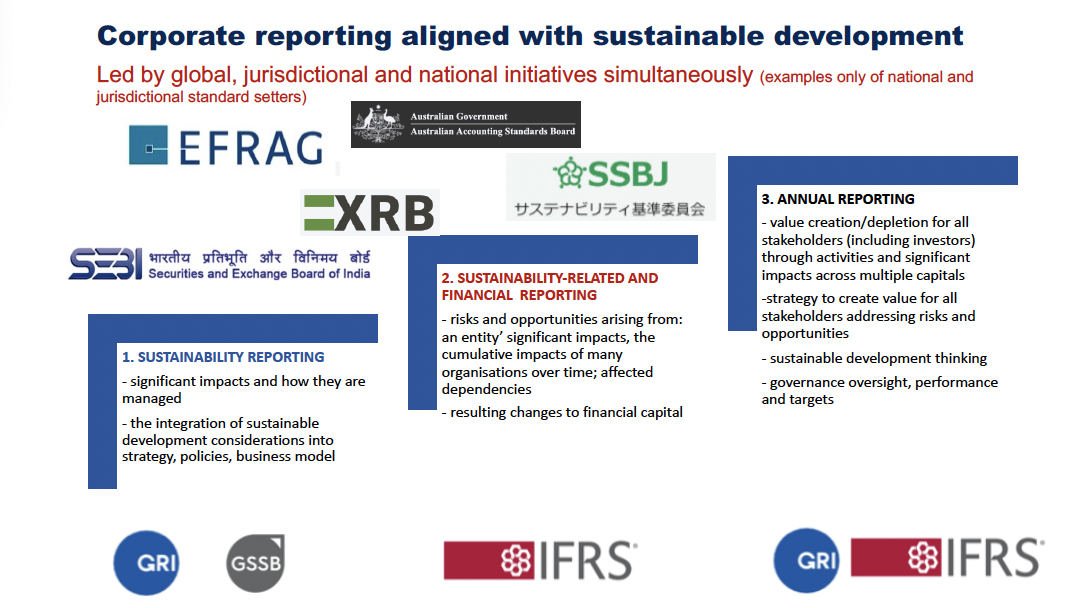
Looking ahead to corporate reporting that meets the needs of investors, economies, people and planet, there are some options. Amongst them, one where global standard setters take the lead together and one where national and jurisdictional developments get ahead and/or go in different directions. The desired end point might could be using GRI and IFRS S Standards set by the GSSB and ISSB respectively and a development of the type of integrated reporting we’ve seen in South Africa by companies that used GRI Standards and the King Code and a move from integrated thinking to sustainable development thinking. In any case, whether we agree or not on the end point, how corporate reporting gets to a place which is efficient and useful for preparers and users depends on collaboration at the global level and/or between global and jurisdicational/national standard setters.
Here are some possibilities, the first showing steps and a progression and the second a more complex, perhaps more painful, and inefficient route, but nevertheless with fruitful outcomes. Of course, national/jurisdicational standard setters will always put their own twist on global efforts as they face very different sustainability contexts and sustainable development priorities. In doing so I would hope they:
- work with regulators in other parts of government (eg those concerned with environmental and social issues) just as we encourage finance and sustainability departments to collaborate; and;
- stay close to tried and test global initiatives where possible.



Thank you for an informative and well structured post.
Rather than phrasing and directing the comment as you have, I would have preferred ‘The Future of Sustainable Development aligned with Corporate Reporting’.
Corporate reporting is becoming a compliance issue (pick your standard), probably overseen by the Legal Director or Company Secretary. We need to progress how an organization’s purpose is aligned in their development of their employees and the society, while regenerating their environment.
Reporting can help tell this story. Personally. I prefer non-fiction to (science) fiction.
Whatever happened to GRI’s sustainability context?
Thanks Glen. Considering sustainable development context is part of the process of identifying an organisation’s most significant impacts in GRI 3. Each sector standard discusses the sustainable development context of the sector and links the required disclosures with the SSGs.